
Article written by
Zdravko Kostadinov
Youth Programme Aide
kostadinov@democracy-international.org

Have you noticed that Gen Z is on the rise against Artificial Intelligence (AI) globally? They do not only ‘’cringe’’ at the sight of the yellow hues and odd proportions on images, but they are also very vocal about their distaste for it.
Even though there’s a common misconception that being chronically online equates to supporting everything technology-related, AI is where many people draw the line. It's almost paradoxical how one of the most tech-savvy generations is so audibly in protest of it. Why does this happen?
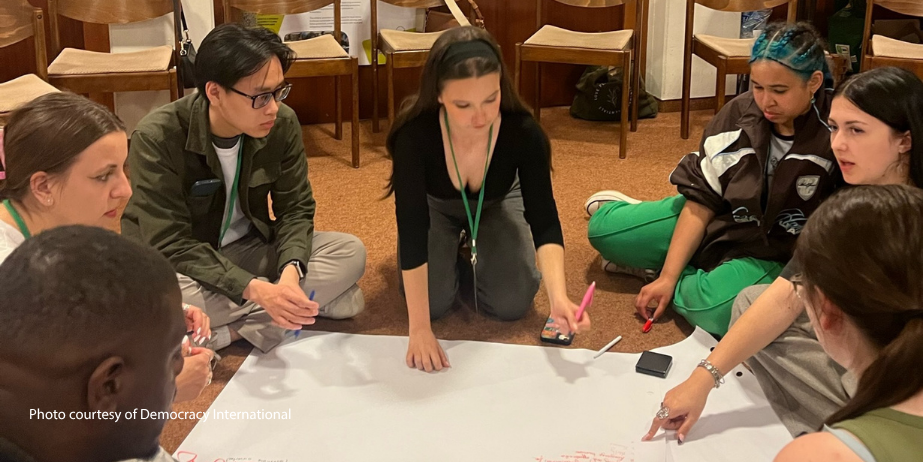
It’s something we have noticed in all youth exchanges we have been to as part of Democracy International’s Youth Programme. Take the Democracy Camp in Germany as our most recent example. During the European Citizens’ Initiative (ECI) workshop, led by our colleague Daniela Vancic, participants had a chance to design their own initiative from scratch – from coming up with the title, to writing specific recommendations to the European Commission on an issue they care about. A hot topic in this discussion was content made with the help of Artificial Intelligence. Specifically, we had a group of participants suggest better legislation around watermarking such content online. They argued that, as much as AI is a helpful tool to accelerate work in many fields, it is also often the main culprit in spreading misinformation, which can harm society in the long run.
Coincidentally (or not so much), other young people have expressed their interest in limiting or labelling AI-content with the idea of supporting human artists and preserving culture. We have seen this in the Youth Bridges Europe exchange. “Thank you for the music” and “AI transparency: save the culture” are two specific initiative ideas that came up. These groups suggested watermarking musical content and demonetising music produced by AI content creators. They argued that if the market gets too saturated, real artists will get less market share from streaming companies. Since there are no regulations, AI companies have an unfair advantage over human content creators, as they are able to make content very quickly with minimal to no effort, while humans have to do the manual labour of creating the work from scratch.
Still, art is not the only concern young people have regarding AI. Among their many worries, sustainability was repeatedly brought up – and for a good cause! According to the report Environmental Cost of Artificial Intelligence: Carbon, Water and Land Footprints (2026) by the United Nations University Institute for Water, Environment and Health (UNU-INWEH), Artificial Intelligence is responsible for worrying amounts of earth-warming greenhouse gases, which increasingly strain the planet’s natural resources. Notably, it also uses considerable amounts of water.
Apart from the moral considerations regarding the protection of artists and the environment, there is also a personal consideration. Artificial Intelligence is now known to affect the cognitive skills of people who use it frequently (Kosmyna et al., 2025).
Have you heard of the Dead Internet Theory? Simply put, it’s the belief that the internet is now largely populated by bots that talk to each other in order to generate traffic and manipulate the masses. Although just a theory for now, it does raise awareness on how bots are able to thrive online, unnoticed. For instance, the Thales Bad Bot Report (2026) shows that they 53% of internet traffic was made by automated bots in 2025.
So, young people may not like AI as much as people think. And we think they are right to worry about all the issues that surround it. Can regulation revert this takeover? If AI usage is not regulated, it will grow, and young people say that it has grown enough. Are they onto something?