Article written by
Caroline Vernaillen
Lead Global Policy & Advocacy
vernaillen@democracy-international.org

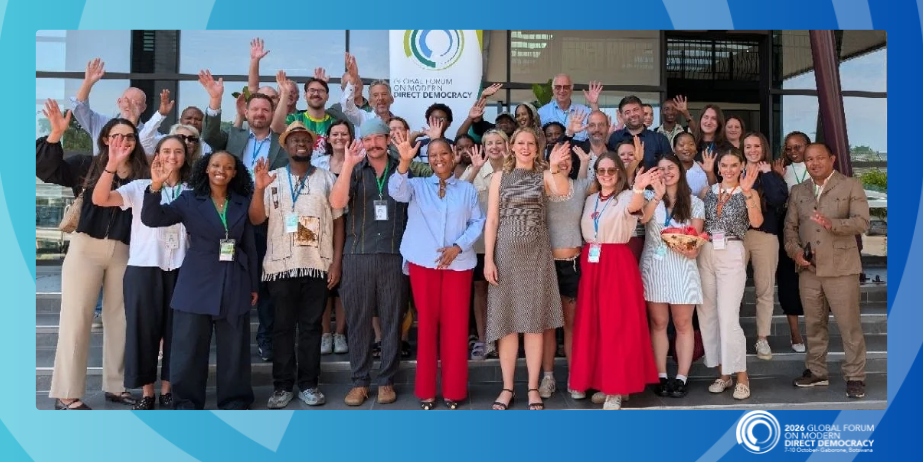
From 7–10 October, 150 participants from five continents and over 30 countries gathered in Gaborone for the 13th Global Forum on Modern Direct Democracy. Across 48 sessions and activities, with 79 speakers, moderators and facilitators, we explored how people can exercise greater influence over the decisions that affect their lives.
Botswana’s experiences gave us plenty to discuss, both inside the conference rooms and beyond them: a university built through public contributions, a visit to Parliament following the country’s first change of governing party and a discussion at the kgotla in Mochudi about how community decisions connect to national politics.
Botswana offered a timely setting for these discussions. Although V-Dem identifies it as one of just 18 countries currently democratising, Afrobarometer found that only 49 per cent of Batswana preferred democracy to any other form of government, down from 62 per cent ten years earlier, while just 45 per cent were satisfied with how it worked. Following the country’s first change of governing party in 2024 and amid constitutional reform discussions, the question was how democratic progress could translate into changes people could feel in their lives. Botswana’s kgotla tradition offered a starting point for exploring how participation beyond elections can give citizens greater influence and help rebuild trust.
Getting to know Botswana
During the pre-tour, we learned how people across Botswana contributed towards building a national university. They gave money, cattle, chickens and what they could afford. Hearing this story at the University of Botswana, our partner and host, gave us an appreciation of the collective commitment behind the institution.
The pre-tour took us to Bahurutse cultural village to learn about Botswana’s traditions. And at Parliament, we discussed the 2024 election, when voters brought a different party into government for the first time since independence. The peaceful handover was a significant moment in Botswana’s long-established multiparty democracy. It also raised a question familiar far beyond Botswana: how can voters see the change they voted for?
We heard about the country’s history, the negotiations that helped preserve its separate status under British protection and the choices made after independence.
Diamond revenues helped finance education, healthcare and public infrastructure. Today, declining revenues are putting that development model under severe pressure. Discussions about natural resources and economic alternatives gave us a concrete introduction to questions we would return to throughout the Forum: who decides, who benefits and how can people influence the choices ahead?
Fifty visitors at the Mochudi kgotla
During the Forum, 50 participants visited a kgotla in Mochudi to learn about community decision-making, its connections to the national level and the place of traditional governance within Botswana’s modern institutions. The visit offered a chance to learn about a living practice of deliberation and to question assumptions about where democratic knowledge comes from.
Three lessons entered the draft Gaborone Declaration: every contribution to a discussion is welcome and every opinion is valued; a chief derives legitimacy from the people; and differences should be resolved through discussion rather than violence.
Kgotla ya Basha, organised by Active and Human, also came to the Forum. They showed how the tradition can be adapted into more inclusive forms of participation. For several participants, this session was a highlight. Together, these encounters demonstrated how inherited practices can inform democratic innovation while themselves continuing to change.
Giving participation consequences
The question of what happens after people speak ran through the programme.
We heard about African experiences with mandatory and constitutional referendums and debated whether these votes can open the door to more participation initiated by citizens themselves. Discussions about constitution-building, including Botswana’s reform efforts, examined how people can influence both the process and the outcome. We also considered what participation in constitutional change could look like beyond the national level.
Youth participation brought these questions into focus. A debate on reserving 30 per cent of parliamentary seats for people under 35 put a specific proposal on the table. Discussions about children’s participation and the contribution from Kgotla ya Basha explored other ways to give younger generations influence.
The youth contribution to the draft declaration was clear: young people want to be trusted as partners in shaping today, with practical opportunities to develop ideas and make decisions.
Keeping useful work going
Democratic initiatives and networks are working with a shrinking pool of funding. We spoke openly about what could be lost: organisations, knowledge, relationships and opportunities for people to participate.
There was reassurance in returning to the value of local work. Initiatives that help people address problems in their communities have something durable to build on. The needs they respond to remain, even when funding priorities change.
In workshops, participants stress-tested democracy and explored how to strengthen resilience before a crisis. Other conversations examined how networks can share resources and support people working in increasingly difficult conditions.
At the multilateral level, we discussed how citizens could gain better access to institutions that make decisions across borders. Proposals such as a World Citizens’ Initiative and global citizens’ assemblies helped us examine possible routes, alongside the considerable obstacles.
Taking the conversation home
The draft Gaborone Declaration brings these discussions together: stronger rights to initiate and vote on laws, more opportunities for deliberation, community influence over resources and support for the people doing this work.
Across the Forum, participants compared experiences, tested proposals and found people they wanted to keep talking to. Some of the most useful exchanges will have been those that helped someone reconsider an approach or find a way through a problem back home.
Thank you to everyone who helped organise, host, fund and run the Forum, and everyone who travelled, contributed and took part. A gathering of this kind depends on a great deal of work, much of it behind the scenes.
We came to Botswana to learn from one another. We left with plenty to think about, some ideas worth trying and new people to call when we get stuck.